Spirituality, Yoga

A New Year – 2023

Today, as we prepare to usher in the new year 2023, I share inspiring excerpts from the New Year’s message of Sri Swami Sivananda Saraswati (1887-1963):

By the command of the Indestructible Being, minutes, hours, days and nights stand apart. By the command of the Immortal Brahman, months, years, seasons and solstices stand apart. [The one] who knows this Indestructible Being is a liberated sage or Jivanmukta.

Time rolls on. New becomes old and old becomes new again. Today is the most auspicious New Year’s day. God has given you another chance this year to enable you to strive for your salvation. Today man is. Tomorrow he is not. Therefore avail yourself of this golden opportunity, struggle hard and reach the goal of life. Make the best use of every moment of this New Year. Unfold all latent faculties. Here is a chance to begin life anew, to grow and evolve and become a superhuman or a great dynamic Yogi….

Be thou a spiritual warrior of Truth. Put on the armor of [spiritual] discrimination. Wear the shield of dispassion. Hold the flag of Dharma. . . . Blow the conch of courage. Kill the enemies of doubt, ignorance, passion and egoism and enter the illimitable kingdom of blissful Brahman. Possess the imperishable wealth of Atma. Taste the divine immortal essence. Drink the nectar of Immortality.

May this bright New Year’s day and all the succeeding days of this year and all the future years also bring you all success, peace, prosperity and happiness. May you all tread the path of Truth and righteousness! May you enjoy the eternal bliss of the Absolute, leading a divine life, singing Lord’s name, sharing what you have with others, serving the poor and the sick . . . and melting the mind in silent meditation in the Supreme Self.

OM shanti, shanti, shanti…. Peace, peace, peace

Photo by Katie Rainbow on Pexels.com
Spirituality

Practical Spirituality

Does spirituality often seem like something “otherworldly” that remains disconnected from daily life? For example, it’s common for people to go to church or temple once a week but then forget about God and devotional practices on the other days of the week. My husband, who attends a weekly meditation group, told me he’d been attending for some time when he suddenly had an insight about the “daily practice” that people mentioned as they checked in with one another at meetings. He realized, “Oh, I’m supposed to be doing this stuff at home on my own!” He then recognized he had a choice about how he spends his time each day. He could sit in front of the TV or the computer, for example, or he could make a point of engaging in spiritual practices. There are formal practices such as seated meditation and informal practices that can be used according to personal preferences.

Here are some ideas based on a talk entitled “Spirituality in Daily Life” by Swami Ramananda from the Integral Yoga Institute, San Francisco, CA:

— Be mindful and present throughout the day while going through activities. Train the mind to focus on what’s actually happening moment-to-moment. This is the practice of “mindfulness.”

— Design a personal mission/purpose statement to inform your daily choices. Why are you choosing to do what you do each day? Are these choices congruent with your mission in life?

— Notice inner conflicts and make a point to relieve them. For example, notice self-judgment and ask yourself where that voice originates. Journaling and/or psychotherapy can be helpful with this.

— Release the pressure of competitive striving. Recognize that other people have their own lives and make their own choices while you are free to do the same.

— Perform all actions as service to God, as devotion. View all of humanity, all of creation, as aspects of God to bring a sense of peace/joy to work no matter how mundane it may seem.

— Engage in creative endeavors such as drawing, painting, dancing, writing poetry – anything wholesome that brings spontaneity and freedom into daily life.

— Work with one spiritual teaching/practice, such as nonviolence or truthfulness, for an extended amount of time (perhaps a week or a month at a time) to begin noticing more subtle levels of the practice.

— Spend time in formal seated meditation, prayer, and/or chanting/singing in Spirit. Stay with the practice long enough in each session until you encounter some sense of inner light/peace to carry into the rest of daily life.

— Incorporate “sabbath time” into life in some way. This is dedicated time for inner spiritual work away from the responsibilities of family life and livelihood. This can be practiced in a variety of ways such as one day per week, or several days of retreat once every 3-4 months.

— Take time to breathe in the clean air of nature. Enjoy trees, flowers, rivers – all the beauty of the earth.

All of the above are suggestions. What others are calling to you at this point?

Photo by Min An on Pexels.com
Sanskrit, Yoga

The Influence of Samskaras

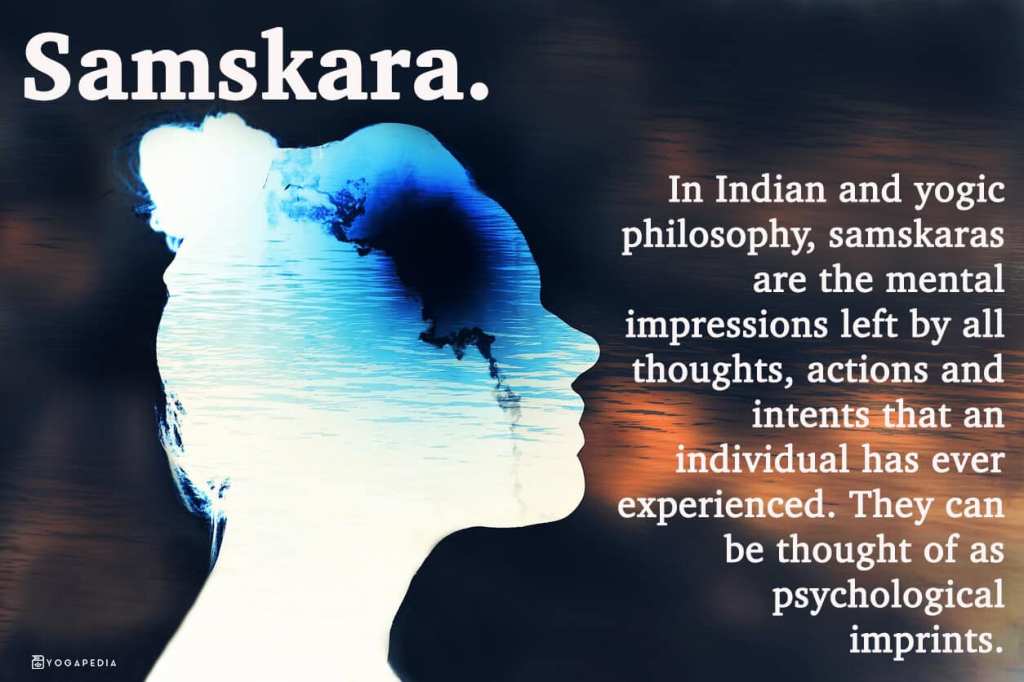
The concept of samskara (a Sanskrit word) is important in Yoga because all the practices of Yoga are designed to train the mind, to clean the mind, to enable us to experience our truest, deepest Self. Samskaras are often visualized as grooves or ruts in the mind caused by habitual thoughts, speech, and actions. The more we repeat specific thoughts, words, and actions, the more deeply they become imbedded in the psyche — and the more difficult they are to change. All of this reminds me of a quote often attributed to the Buddha or to Lao Tzu (and repeated by luminaries such as Mahatma Gandhi and Ralph Waldo Emerson):

“Watch your thoughts; they become words.
Watch your words; they become actions.
Watch your actions; they become habits.
Watch your habits; they become character.
Watch your character; it becomes your destiny.”

How does Yoga help change this sequence? Yoga teaches us to become fully, calmly observant of the present moment — each and every moment, one after the other. In this way, we become the Witness of our own thoughts, emotions, speech, and actions, thereby beginning to see that we are something More than all of these. We begin to notice we always have a choice about the kinds of thoughts, etc. we cultivate. When unhelpful or unhealthy samskaras come to the surface of the conscious mind (after continuing to exist for some time in the unconscious or subconscious mind), we learn to watch and breathe through them as we practice responding in new ways rather than rolling along through the old familiar ruts. Yes, this takes a lot of practice! This is also an example of the many ways Yoga can revolutionize our daily lives from the inside out.

Vibrant Health

Holistic Health

Here’s inspiration from Sri Swami Satchidananda on what it means to be whole, to foster holistic health. I love his metaphor!


Each person is a mixture of so many things: there is a physical side, a vital side, a mental, moral, intellectual and ultimately, a spiritual side. If we really want to lead a better life, a divine life, we should develop all these different aspects within ourselves. It is something like a motorcar: it should be perfect from the motor to the muffler. Everything in the car—the engine, radiator, battery, tires, brakes—all must be in perfect condition. Last but not least, the spirit (what you call the petrol or gas) must be of good quality too.

Which part(s) of you are asking for special attention from you at this time?

Photo by Pixabay on Pexels.com
Vibrant Health, Yoga

The Power of Relaxation

I was recently reading excerpts from the book, Hatha Yoga, written by Swami Sivananda and originally published in 1939. He has a wonderful section on why relaxation is important. In my yoga classes, I like to remind students that while it’s important for the body to know how to work hard, it’s also important for the body to know how to relax. Normally, we think of relaxation as sleep. Some people think of it as laziness. But true relaxation is neither of these. Here’s what Master Sivananda has to say:

“Life has become very complex in these days. The struggle for existence is very acute and keen. There is very keen competition in every walk of life….

If you practice relaxation, no energy will be wasted. You will be very active, and energetic. During relaxation the muscles and nerves are at rest. The Prana or energy is stored up and conserved. The vast majority of persons who have no comprehensive understanding of this beautiful science of relaxation simply waste their energy by creating unnecessary movements of muscles and by putting the muscles and nerves under great strain….

Do not mistake laziness for relaxation. The lazy man is inactive. He has no inclination to work. He is full of lethargy and inertia. He is dull. Whereas a man who practices relaxation takes only rest. He has vigor, strength, vitality and endurance. He never allows even a small amount of energy to trickle away. He accomplishes wonderful work gracefully in a minimum space of time….

The science of relaxation is an exact science. It can be learnt very easily. Relaxation of muscles is as much important as contraction of muscles. I lay great emphasis on the relaxation of mind, nerves and muscles. For relaxation Savasana is Prescribed.”

——————————————————————————–

And savasana, of course, is the “final relaxation” pose of yoga. This pose is practiced after all of the more active asanas have been completed. This pose is often only practiced for three minutes, but the full benefit is experienced when the practitioner remains in the pose for 5-30 minutes. Feel free to meditate on the breath or use a recording of yoga nidra during this time. And yes, this pose can be practiced all by itself!

Be well! OM shanti… peace, peace, peace….

photo from SHAPE magazine