Yoga

How to Explain Yoga?

At the end of every semester, I ask my university yoga students (physical education) to answer the following question: “How would you explain Yoga to someone who knows nothing about it?” Here are two responses I received this year.

“To someone who has never practiced nor known anything about the experiences yoga can bring a person, I would describe it as follows: ‘It’s something older than you would think which has been brought into our culture as a fad, but it has helped us nonetheless. It’s a spiritual connection you have with the universe around you and with your own body that no one else can critique or feel or even imagine. Every experience is unique to the person practicing. It’s a beautiful thing combining body and soul if you desire and practice, or it can be used as a significant exercise regimen. There are so many ways to enjoy and participate, and my knowledge hardly scratches the surface.'”

“The best way to explain Yoga to someone who knows nothing about it is to think of themselves as Gumby. Gumby is a character who is green and made of clay, allowing him to stretch to all shapes and sizes. His stretchiness allows him to twist, pull, fold and flex—all things that occur in Yoga. While he returns to his original form after each stretch, it’s clear that it has taken a toll on him and he needs time to relax afterwards. In Yoga, all poses require some form of flexibility and the skills Gumby has. At the same time, the practices of concentration and meditation are things Gumby must do to carry out a task but to also reflect or heal from it afterwards. Gumby was one of my favorite shows growing up and I think this little green character is the best way to explain Yoga to someone who knows nothing about it. Using cartoon characters makes Yoga less scary and relatable in a sense that touches your inner child.”

Vibrant Health, Yoga

A Dream Job

What’s your dream job? I’ve heard it said, “Do something you love for your job/career, and you’ll never work a day in your life!” I agree with this, because if you’re doing what you love anyway, you’re automatically having fun and it doesn’t feel like “work.”

I am fortunate to be in my “dream job” as a yoga teacher. How did I get here? Well, I didn’t set out to do this for a living, rather, it came to be as an outgrowth of what I had already been doing. Here was my journey: dance student, fitness instructor, yoga teacher. I loved dancing and loved working out and teaching fitness. I was already doing all that when yoga started becoming popular in gyms and recreation centers. So, stepping into yoga teaching was a natural next-step.

It also helps that I’m naturally gifted with the abilities that yoga instruction requires. Here’s a post I wrote about the career placement test we took in high school: Living our Gifts. And while I love teaching yoga, I have also obtained education in other areas that interest me such as counseling and spiritual direction. Therefore, I also think it’s possible that our dream job can continue evolving throughout our lives. Maybe it even should keep evolving. That way, we never get stuck in a rut or feel bored.

So, while I love what I’m doing now, I can also see the possibility of my career moving to a place where I can combine all my skills and interests into one place, where physical fitness meshes with mental/emotional health, and spiritual guidance. Ah, see?! This is a perfect description of Yoga Therapy. I honestly believe everyone deserves this type of holistic health.

I’m open to your questions and comments about what a “dream job” is, and about what yoga therapy is and how it can help you.

Peace to all!

#bloganuary

Vibrant Health, Yoga

Practice Meditatively

I believe I understand why depression and anxiety are so prevalent in the United States and other Western countries at this time.  I’ve met many people, especially through teaching Yoga, who are peace-loving, kind-hearted, and compassionate.  Such people are doing the best they can to live good, wholesome – even deeply spiritual – lives, but they are overwhelmed. 

It’s hard hearing about the constant wars going on around the world, the effects of climate change, the greed and lies of politicians, sky-rocketing prices of housing and other necessities, and various scandals.  It’s tough not to feel beaten down by all of this.  And of course, if we’re honest with ourselves, we can also see our own weaknesses and mistakes which contribute to the pain of life in this world. 

All of these conditions are quite normal reasons for feeling depressed and anxious.  Basically, for most people dealing with mild depression and anxiety, there’s nothing really wrong!  (Note: Yes, there are serious, even life-threatening cases, which are something different requiring specialized medical attention.)

I believe the major problem is that people have not been taught how to manage their own thoughts and how to work effectively with their own emotions.  Physicians are not taught about this; they are taught to prescribe medication.  A quick and easy “solution.” Therefore, the vast majority of people who are taking medication for depression or anxiety don’t really need that.  They need to be taught to slow down and pay attention to what is actually happening inside them.   

Example from Medical News Today: ”The data available suggest that low serotonin levels do not cause depression. However, this does not mean that doctors will stop utilizing antidepressants as a treatment option. Instead, it calls for more research about why antidepressants work the way they do.”  I wonder if low serotonin is actually an effect of being depressed for a while.

I have seen many Yoga students who come to classes regularly because they know (consciously or unconsciously) they need to slow down and listen within themselves.  They know there is something about Yoga that helps them feel better, something that gives them practical tools to bring into daily life.  Indeed, yoga philosophy teaches we are so much more than the physical body we tend to emphasize.  Besides the physical body, we have our energetic body, mental/emotional body, wisdom body, and contentment/bliss body.  These are the five koshas (sheaths) of our body.  Yoga helps us feel better because it addresses all five of these sheaths, and it helps us connect with our deepest sheaths of wisdom, peace, contentment, bliss.

Yoga is meant to be practiced meditatively for the greatest mental and emotional benefits. Forcing the body to perform fancy poses can cause injury. Practicing with goats or other external stimuli teaches the mind to keep reaching for distractions to numb emotional pain. Nothing special is needed for the practice. All we need to do is show up with an open mind and heart, trusting the process. 

A single practice session helps us feel better. Over time, the cumulative effect is even greater. I invite you to practice any way you can, whether alone or with a group or with a private yoga therapist. Look and listen deeply within yourself. Trust what you find there even if it’s sometimes painful because the very act of looking and listening begins the process of healing.

Spirituality, Vibrant Health, Yoga

The End of Seeking

Two months ago, my husband and I attended a retreat with Rupert Spira at the Garrison Institute in New York. The retreat included daily 90-minute meditations in the mornings, plus 2-hour Q&A sessions with Rupert in the afternoons. We also had plenty of free time for journaling, yoga practice, and hiking on the beautiful trails near the Hudson River.

The following is a reflection from one of my journaling sessions based on what I was hearing and experiencing at the retreat:

At some point, all religions fail us. They can’t give us what we truly desire because we already ARE THAT! We already have what we most desire. It’s like Dorothy in the Wizard of Oz. After all her wild adventures, she realizes there’s no place like home. That “home” is our True Self, our Being Itself.

Spiritual seekers have given up seeking in other areas of life — status, money, power, relationships, etc. — and instead, focus all their seeking in the spiritual realm. This, then, becomes a difficult habit to break.

All we REALLY want is the experience of ultimate peace and pure unconditional love. And really, all we need to do is look deeply within ourselves and rest there. THERE is peace, love, and joy!

Giving up spiritual materialism, teachings/practices, and teachers is the most difficult step for seekers. This is the Buddhist teaching: “If you see the Buddha on the road, kill him!” Also: Use the raft (teachings, practices, beliefs, teachers) to get to the other side of the river, but once there, leave the raft behind; don’t continue to carry it. Know that it has served its purpose.

The journey is complete in pure Being. We were already there as infants but we didn’t consciously know it. Now, we can KNOW and BE in pure Being.

What does this feel like? Sometimes it feels like nothingness. This is Peace. We only have to recognize the experience as Peace rather than boredom or some other mistaken perception. Sometimes pure Being feels like fullness, full of something like energy or Love. This is joy, bliss (ananda in Sanskrit). 

Pure Being is BOTH Peace and Bliss/Love. It is both and perfect. WE are both and perfect already! All we have to do is remember this, our True Self. The more often we look deeply within and remember, the easier it is to live our lives from this center of Being.

And this is what the world needs more than anything: People who are living their lives from Pure Being: Peace, Love, Joy! May it be so! Amen! OM… OM… OM…

Photo by Pixabay on Pexels.com
Yoga

Yoga in the World

Did you know that your full-time Yoga Teachers struggle to survive on teaching? Here’s an excerpt from a Yoga Journal article on the results of the Yoga Alliance research study on “Yoga in the World,” 2022:

Survey Says: In the U.S., nearly 75 percent of the teachers surveyed indicated that leading yoga classes is their primary source of income.

Context: Most yoga teachers are contracted at a flat rate for the hour spent instructing a class. Compensation for an hour-long yoga class varies dramatically depending on teaching experience and other considerations. Although the survey did not indicate income, compensation for a studio or gym class typically falls between $20 and $50.
That rate does not include the time spent commuting, answering students’ questions, preparing the sequence for class, and creating a playlist. There is also no compensation for transportation, music streaming platforms, or continued training.

Many full-time teachers consider a full schedule to be approximately 15 classes a week. Newer yoga teachers tend to enthusiastically take on more classes a week than is sustainable, and eventually lessen their schedule—and their take-home pay—to reflect reality. Do the math and the challenge inherent in teaching yoga to the exclusion of any other work becomes apparent….

Many full-time yoga teachers supplement their studio income with one-on-one yoga sessions, teaching at higher-paying corporations and resorts, leading workshops, retreats, or yoga teacher trainings. Those teachers will tell you it’s a hustle culture. And it’s exhausting….
The irony of this stress is not lost on teachers and studio owners. Yet there are also implications for students. What do we lose when knowledgeable teachers with diverse backgrounds and experiences can no longer afford to share their time and talents? What happens when those responsible for sharing yoga are unable to afford the time or tuition to further their studies?

——————————————————-

While our students may highly value what we’re offering, our employers (mostly) do not. Our society in general doesn’t appreciate the hundreds of hours and thousands of dollars of training we’ve undertaken to be good at what we do. Nevertheless, those of us who are called to this teaching persevere as best we can.

Access the full Yoga Journal article HERE

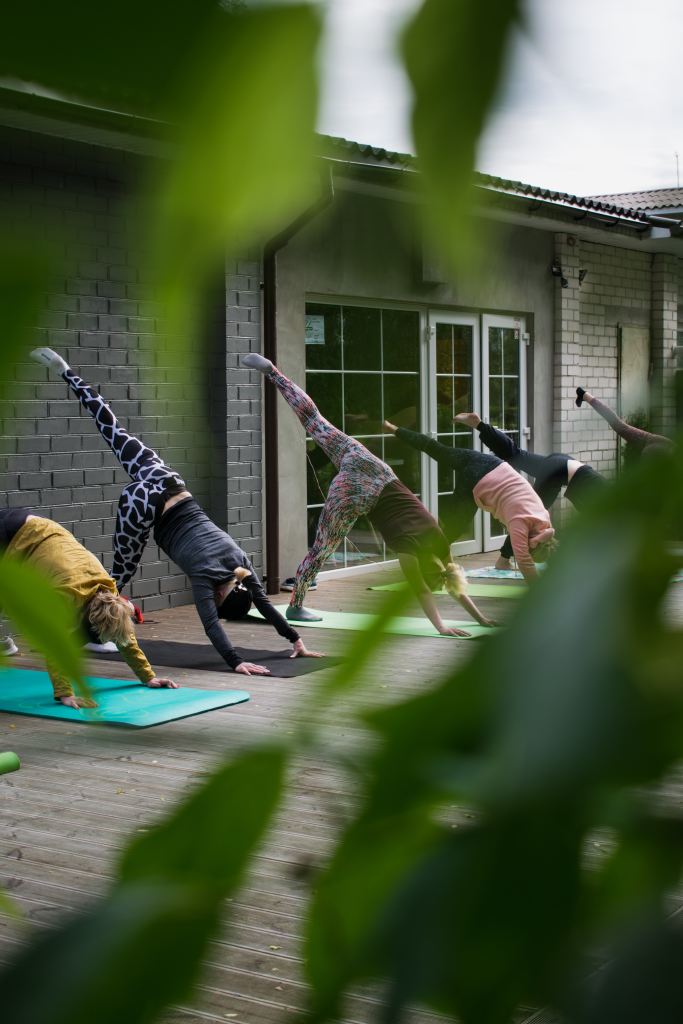
Photo by Rima Kruciene on Unsplash